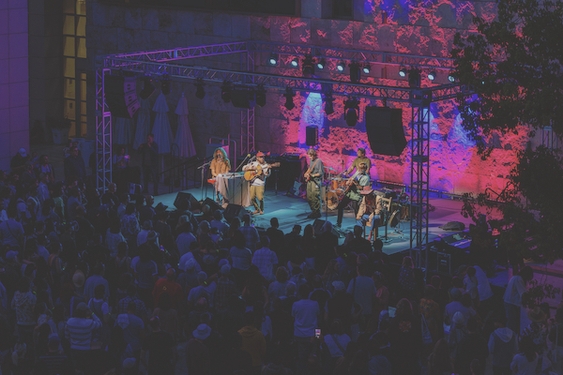

The California Science Center recently hosted an unveiling of a portion of the newly constructed Samuel Oschin Air and Space Center in downtown Los Angeles. The building is a stunning architectural gem designed by LA’s own ZGF Architects.
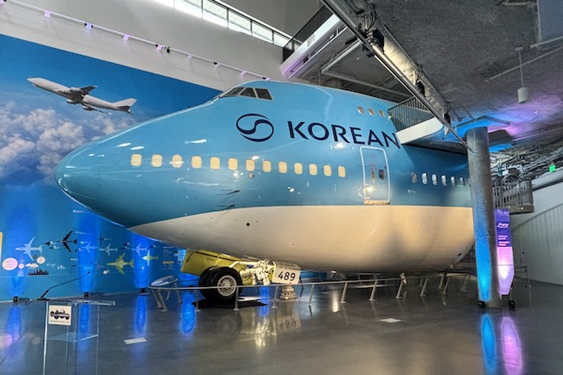
I had the opportunity to explore the Korean Air Aviation Gallery, which currently houses a 70-foot section of the front end of a Boeing 747-400 fuselage from Korean Air, along with a suspended Grumman F11F-1 Tiger jet positioned high above the gallery floor. The interior of the building is absolutely epic, and when completed, the gallery will house approximately 25 aircraft.
The purpose of the Korean Air Aviation Gallery is to explore humanity’s pursuit of mastering the skies through the four forces of flight: lift, thrust, weight, and drag. As explained by guest speaker Dr. Perry Roth-Johnson (curator of science and technology at the California Science Center), the gallery is divided into three primary thematic areas: Learning to Fly, Everyday Flight, and Advanced Aviation. Visitors will gain a deeper understanding of how these scientific principles affect every aircraft ever flown.
In addition to Dr. Roth-Johnson, attendees at the unveiling ceremony heard from Jeffrey Rudolph, President and CEO of the California Science Center, and Walter Cho, Chairman and CEO of Korean Air. Dignitaries from Boeing also attended the event.
According to the California Science Center website, the Samuel Oschin Air and Space Center will integrate authentic artifacts, including a diverse collection of aircraft and spacecraft, immersive experiences, and signature hands-on educational exhibits designed to encourage active learning through discovery. The new galleries will inspire guests of all ages to better understand the scientific and engineering principles behind atmospheric flight and the exploration of our universe.
In addition to the Korean Air Gallery, the Kent Kresa Space Gallery will feature three thematic areas: Rocket Science, Robots in Space, and Humans in Space. Meanwhile, the Samuel Oschin Shuttle Gallery will reveal how the world’s first reusable spacecraft, the Space Shuttle, helped humanity learn to live and work in low Earth orbit while preparing for more ambitious and distant missions. The California Science Center will become the only place in the world where visitors can see a complete Space Shuttle System featuring the flown orbiter Space Shuttle Endeavour mated to real solid rocket boosters and ET-94, the last remaining flight-qualified external tank.
With more than 100,000 square feet of space, the center and its collection will be unmatched. This Southern California destination stands as a monument to the contributions Californians have made in humanity’s quest to reach the Moon and beyond. Such achievements would not have been possible without the contributions of Southern California’s aerospace industry, which will be showcased throughout the Oschin Space Center — from the Project Mercury through the Apollo program. Of course, modern contributions from SpaceX will also be featured, including Dragon capsules that have been ferrying astronauts to and from the International Space Station.
The projected opening date is expected to be announced this summer, though officials at the California Science Center want to have the facility open before the 2028 Summer Olympics.
On a closely related note, Southern Californians are often reminded — during rocket launches streaking across our skies — just how far aerospace technology has advanced over the last 70 years. Soon, visitors will have the opportunity to explore that history and learn how it all works at the Samuel Oschin Air and Space Center in downtown Los Angeles.
For more information about the Samuel Oschin Air and Space Center, visit California Science Center.
 Comment